Showing posts with label Warhammer. Show all posts

Tuesday, November 4, 2014

On Cheating, Honor, and Competition

Mike posted about me the other day.  It went something like this:

Seth.  Hey Seth.  Seth.  Seth, hey Seth.  Seth.  Write something.  Hey Seth, hey, write something.  Write something, Seth.  Write it.  Write something.  Seth.  Thanks. (write something).

Or at least that's what I got out of it.  Unfortunately, I didn't really know what to write about.  The tournament scene for miniature wargaming is winding down in this area, and most of you tune in for those pictures.  I'd covered most of the cons that went on, and the few that I had been to did not have large scale competitions.  None of you had any good ideas, so I was sitting around until my friend Dan tossed this little gem into my lap:

"Hey, did you hear about the Feast of Blades tournament in Denver?"

Google Search.  Read read read.  ooooooOOOOOOOoooooohhhh.

Apparently the champion of the tournament was accused of cheating, and immediately disqualified himself.  The allegation came from another person, who had found one of his dice under the table and saw that the die was not fair.  The champion made a public statement where he apologizes for the mistake.  He chose to disqualify himself and bow out of the tournament, declining his prize, trophy, and recognition.  Words like "honorable" and "do the right thing" and "honest mistake" were used to describe the situation.  Huh.  Ok, we'll come back to that later.

Wednesday, August 6, 2014

Necromancy at the Bay Area Open 2014


Spoiler Warning: These guys win.
The first time I ever heard about Warhammer 40,000 was when my neighbor Corby came over and saw my brother and I playing Weapons & Warriors. He said it looked similar, and we thought that was cool, so he tried to teach us. We tried to get into it, but he wisely warned us not to. The cost of this particular wargame is little much for a 10 year old. We loved looking at the pictures, and my first memories of this game are pictures in a magazine and extrapolations from our imaginations. 16 years later, the hobby has changed significantly, and my understanding for the game, the lore, and the hobby have developed. The magic, the possibility, that wild, unfounded extrapolation born of inspired imagination is mostly dead. I say “mostly,” because after last Sunday, I will never say “dead” again. Well, except that I will, but I’m reminiscing here, cut me some slack.

Cut him some slack too, it's not easy being green.
I started playing Warhammer 40k when I was about 14. My friend got a bunch of models from his dad, and I bought some with my allowance, and we tried to figure out how to play. We went down to the local comic book shop on Saturdays and bit ankles until people took pity on us and let us join in. We met nerds for all walks of life, all ages, genres, and stereotypes. Goths, bikers, teachers, bouncers, software developers, insurance agents, we all had something in common and it brought us together once a week. I was raised by my parents every morning and evening, by my teachers 5 days a week, and by the foul mouthed, uncouth, irreverent, tough loving nerds of DNA cards and comics one day out of seven.

Monday, July 28, 2014

What's shaking in the Largest Warhammer Fantasy GT on the West Coast


Saturday and Sunday of the July 19th and 20th weekend saw a great deal of violence in San Francisco at Fort Mason. Blood was shed, brave warriors fell, and cries of great beasts were heard throughout the land. You did well to avoid this conflict if you are 28 mm high and made of plastic, resin or pewter. However, if you are closer to 6 feet, flesh and blood, and interested in the game of Warhammer Fantasy Battles, you may have missed the Quake City Rumble.

I’ve written about this game before, so skip this paragraph if you know what’s going on. For those of you new to my column, Warhammer Fantasy is a tabletop miniature game played by two or more players. Each player selects an race and builds a force from the rules governing that race. Armed with tape measures and a fist full of dice, they do battle by moving their models over a battlefield, resolving cannon shot and monsters breathing fire by comparing their die rolls to unit statistics and charts. Armies are comprised of several different sorts of troop types: Characters, the great leaders, mages and fighters that command units; Infantry, the grunt troops that slog into battle on their own two feet; Cavalry, units that ride into the fight atop all manner of mounts; Flyers, units that are able to travel great distances over the heads of their foes; Monsters, including monstrous infantry or monstrous cavalry, whose presence alone can make troops turn tail and flee; and War Machines, engines of destruction that lob great stones, or launch spears through the air. Each unit has a point cost and an availability, so for this tournament, players put together 2500 points worth of models and deploy them on the battlefield. Games last for 6 turns, and the winner is typically the one who destroys the most stuff. At least, I assume that’s true, since I wrote it last time, and no one called me out on it.


"Yeah, that guy's right!"

The Quake City Rumble (QCR) is one of the big names of Grand Tournaments in the country, and organized by the gaming club Leadership 2. You might recognize this name from a host of finalist lists around the country. These guys get around, and place highly pretty much everywhere they go. They also have one of the snazziest websites that I have I seen for a gaming club.  By the way, the name is a play on the Leadership stat from Warhammer. A Leadership score of 2 is the lowest in the game. For a bunch of guys that make goblins look disciplined, they sure know how to put a tournament together.

A Grand Tournament is a minimum of 2 days, 5 rounds, but they usually run extra days with events before or after so people who come in from out of town get a few more games. The Quake City Rumble is no exception. I talked to Jared and Rex, members of the Low Comp Crew, who played a team tournament Friday night against their rivals, Bizarro Hammer. LCC went 1 for 4 in that match up, and continued the friendly rivalry between their two clubs. These sort of competitions build friendships and bring together people from different areas to see new armies they haven’t played against before. LCC pulled no punches laying the blame on each other on Sunday when I spoke to them about it. Wherever gaming goes, good old fashion shit talking is never far behind.


The primary reason they are called the Low Comp Crew
That was one of the motivations of the players that I talked to: you go to a tournament, meet other like minded people, and play against people that you haven’t seen in a while. In the first round of the tournament, no one has any standing or score, so (in theory) everyone is on an equal footing. QCR is set up to allow you to request a specific opponent for the first match, in what is called a Grudge Match. Some players request friends from other clubs, people they played against in the past, or someone new they might not get a chance to play against. I also heard talk of last round grudge matches. These keep things interesting for people who have taken enough losses to knock them out of the race for prizes, and would like to play a game against a friend, or another interesting army. Maybe you played 3 games against Elves, and you can’t stand to face another pointy eared bowman, you can request to play empire with cannons, or daemons with 100% fear causing models. Ok, maybe I’m not selling it, but you get the idea.

I got a chance to talk to Mike Hengl, the tournament organizer of QCR for the past 4 years. Along with Ivan Jen, Josh Frick and Jeff Suess, Hengl rents out building D at Fort Mason. They bring in dozens of tables, game boards filled with terrain, a concessions stand, and two or three kegs of beer. If you were one of the lucky first 60 people to early register, you are given a commemorative pint glass and a bracelet that entitles you to all the beer that you can drink until the kegs run dry. Ages 21 or older, void where prohibited, please drink responsibly, alcohol may inhibit your ability to make sound tactical decision and in some cases handle models safely. In case there is any question about the nature of this pre-registration policy, it has a really convenient title: FREE BEER.


He wants some Free Beer.

Hengl said that they received 107 sign-ups this year, and that this is pretty typical for them. Over the course of the 5 years he has run it, they have stayed steady at 90-100 people. Their limit is 112, so they shoot for a fairly precise target. After a few cancellations and withdrawals, they had final scores for 99 people. What makes QCR so big is the draw of people from across the country. Leadership 2 has a rivalry going with Hangover Heroes of Texas, a club that runs The Alamo GT in San Antonio, Texas. HHoT sent a contingent of 8 armies out to try to take the trophies of LD2. Hengl said they had gamers from South Carolina, Wisconsin, and in past years Alaska. One of the downsides to having this many people, Hengl said, is that they can’t run a 40k tournament at the same time. They have some players that mainly play 40k but dust off their Fantasy models once a year to play QCR. They would need another set of organizers, and another location. The only other one that would work is three times as large, a little too spacious for a start up tournament.

Like SAWS Challenge and the other North American Indy GT’s, QCR has no escalation or official participation to other tournaments. These are all done for the love of the game, bragging rights, and a handful of prizes given out to the winners. Hengl does talk to the organizers of SAWS, West Coast GT, and other GT’s to coordinate a few details, like tournament rule interpretations, and composition scores. He says that he wants to keep a diverse tournament environment for players. While QCR has comp score awarded by the decision of judges, SAWS Challenge uses an objective scoring sheet that players score on their own. Other tournaments say play what you want, as long as it is legal. For QCR, they back this score up by sending the “Best General” award to the player with the highest combined Battle Score and Comp Score.

Prize support from the manufacturer, Games Workshop, is non-existent. Endgame of Oakland helps out with prizes as a portion of their sponsorship of the event, and some of the registration money goes to paying for prizes, while other prizes are donated by people who want to see the tournament continue. This is one of the primary reasons that GT’s like QCR continue: people want to play Warhammer Fantasy as a community, not as a strictly competitive sport. To that end, QCR is considering a paint requirement in the future. Hengl is tossing it back and forth: on one hand you don’t want to invite a club from 2 states over and have them turn up and play against a bare plastic army. On the other hand, there are players he knows that started their first tournament with half unpainted models, and are now serious contender for the painting awards.

I talked to some of the players about their experience in Warhammer Fantasy and in the tournament scene. Jared Briscoe of the Low Comp Crew says that the number of people playing stays about the same. New people will show up, older people will leave, but the game lives on. He noticed more and more people are coming in from further away. Hengl mentioned this as an attraction for a lot of players: QCR is one of the few tournaments set in the middle of a tourist city. Fort Mason is a national park, and if you step outside the venue, you are deep in the heart of San Francisco. West Coast GT is an hour out of Los Angeles. SAWS Challenge is a 20 minutes drive from downtown Sacramento. A tournament set up in the middle of a city with an over the top nightlife is a draw for a lot of players.

Jen Starling came up from Orange County with Club Capri. When I spoke to her at the end of the 4th round, she was 3 and 1, and looking for a good fifth game. Her Daemons of Chaos list is called Attack of the Poop Monsters, and thoroughly disgusting to look upon. I asked her about the game and the tournament scene, and not surprisingly, she enjoys it. She used to play Warhammer 40k until a few years ago when the game became more competitive. She noticed a very different attitude between the 40k and Fantasy players, and didn’t really like the spirit of the game any more. She’s been playing Fantasy for 4 years now, and performing decently at it: 38th of 99 in QCR, 54th of 100 at Waaaghpaca in Wisconsin (yes, that is a real tournament, and no, it is not easy to find if you have never seen it spelled before), 54th of 68 at the Alamo GT in San Antonia, Texas, and 16th of 54 at the West Coast GT, local to her in Southern California.


Hengl is hitting up a bunch of these tournaments as well. Crossroads GT in New York had 102 players, Lone Wolf if Dallas Texas had 82, SAWS Challenge had 60 players, and Bragging Rights Team Tournament had 72 (18 teams of 4). There are also a ton of smaller 3 round tournaments all over the country, to numerous to name. If you want see one covered on Ace of Geeks, let us know.

Seth Oakley is an educator and Returned Peace Corps Volunteer who lives in Daly City, CA. He loves costuming, analog gaming and role playing games. He got this job in a bar after making poor life choices and has to work through 93 more articles before Mike will give him his soul back. If you would like to see the complete album of photos taken, tell Mike in the comment box. I took 60 photos, so a gallery or slideshow would be cool, right guys? Right?
(Please also leave a note telling Mike how to DO that on Blogspot. - Ed)

Did you enjoy this article? Follow us on Facebook to get more great content! We have a weekly podcast you can find on our main site. Also follow us on Twitter and Tumblr!

Thursday, June 12, 2014

The Super Blood Bowl, er, wait, The Blood Super Bowl, hmm, no….. by Seth Oakley


On Thursday, my friend Tau Kid messages me and tells me that the championship game of the Seaside Blood Bowl League is this afternoon at 4, and if I want to cover it for the Ace of Geeks podcast and blog, I should show up. His name isn’t actually Tau Kid, it’s Steven, but I’ve called him that for as long as I have known him, and I don’t feel like giving up traditions today. I show up at Anime Imports, the shop where the game is to be held (and hereafter known as Anime Imports Stadium), and there are about a dozen screaming fans there to watch the match. By “screaming fans,” I mean “stereotypical nerds,” and by “watch the match,” I mean “ignore Blood Bowl and play Magic.” Oh well. Steven, Lee, and Efren are crowded around a Blood Bowl mat and the game is about to begin.

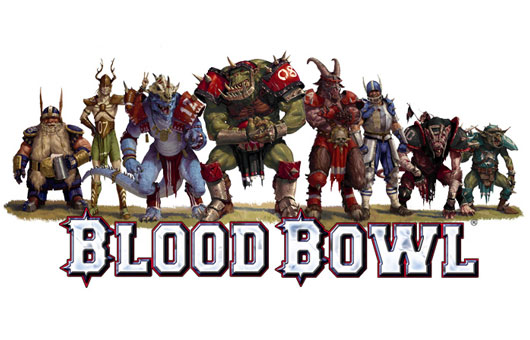
Blood Bowl is a game created by Games Workshop and then handled off to Specialist Games. It would have died when Specialist Games folded, but the fans picked up the banner and now maintain a "Living Rule Book" that is shared among players. I think "Undead Rule Book" would be a little more appropriate, considering that they are essentially playing with the corpse of a previous rules set, but that’s not for me to decide. Now the rules are maintained by an organization called NAF World Headquarters. In the original rules, NAF stood for Nuffle Amorical Football, the fictional organization that controlled the fictional league. If you think that this is a parody of “North American Football,” you might be right. It is a game produced by Brits that exaggerates the violence and mayhem of Football as Americans know it.


Doesn't look THAT exaggerated. -Ed
The game is played by 2 humans that control a set of models which represent players in the game. The teams available come from the Warhammer Fantasy setting, so you will see elves, facing off against dwarves, orcs and goblins, ogres and minotaurs, skeletons and zombies, and more. NAF is constantly approving additional teams. Furthermore, there are a number of miniature lines that sell a variety of fantastical football miniatures. These include gnomes in mechs, platypus sportsmen, and dwarves with beer helmets. Players also convert and sculpt a lot of their own miniatures, since there are so few models compared to other games by the same company. With only 18 or so models to assemble and paint, many players have more than one team.

League play starts off by the human “hiring” a team of players and playing games with the same list. Injuries, upgrades and even deaths are tracked as the seasons progress. Rosters change as teams win games and get more money to hire new players, or retire older players that don’t help them out. All of these are tracked on the league website, seaside.bloodbowlleague.com. This league has a round robin format: each player is scheduled to play another and given two weeks to find time for a game. The results are then reported to the league managers and recorded for the next round. Once everyone has played everyone else, the top two teams are given byes, the next four put in the playoffs to determine who will make it to the semis. The top two teams of the playoffs then play in single elimination tournament with the two who received byes earlier.

First place is given the top prize, a full 18 model team, purchased with the proceeds from the entry fees collected at the start. Steven said there were 11 teams this season, which is on the high end for them. Typically they have 8 to 12 teams, and it takes about 5 months to run an entire season. They had 2 “Challenges” so far, smaller events with 3 or 4 teams. Registration for season 5 is coming up, so if you are interested, head on over to their website.

photo.JPG

The game I watched was simple enough to understand in observation, but the moves and maneuvers made by the players definitely had a hidden logic to them. The championship match was between Efren and his Rage City Brawlers, a Chaos team, against Lee and his Rotland Reapers, an Undead team. The Reapers started off with the ball and proceeded to run it up the field to score. There was a lot of pushing and shoving from both teams, rolling of dice and moving of models. Finally a hole in the defense opened up and the Ghoul ball carrier went for it. Efren brought up one of his half beast, half man defenders to hit him, knocked to ball out, and we all watched as it bounced over the pitch. Off the back of minotaurs, over the thick skull of zombies, past the mummy line man, the ball knocked its way around the pitch (moving randomly on the determination of a die roll), until it landed in open space. All the while, players are still beating on each other, pushing each other around, and tossing the opposing side into the stands. That last part is especially rough, since the fans are so blood frenzied that they can do more damage to a player than some of the players.

And that is the spirit of blood bowl. What looks on the surface to be a silly parody of a game we know, made by people an ocean away who are ridiculing it for being exceptionally violent, is actually a strategic game where the bouncing of a ball make the difference between victory and defeat. Beneath the “beer and pretzels” facade is 10 games of team planning, player acquisition, injury management, blood, sweat, tears, and lot more blood. Humans keep careful records of the game progress, who injured who, what skills that guy has, and when they should use the re-rolls that are purchased at the beginning of the game. If one of your players is a wild animal, who knows what he is going to do next round? Do you rely on him to make an important tackle, or do you draw resources from somewhere else in case he doesn’t listen? These sorts of questions show on the faces of the coaches as they puzzle out their next move, and consider their options. Don’t let the goofy looking cheerleaders or the medic model with a bone saw in one hand and oversized syringe in the other fool you: this is still a thinking man’s game.

The community in the US is not that large, Steven says. They have a league of 8 to 12 regulars. They have contact with the Freebooters Alliance Blood Bowl League, a southern California league. There's also the West Coast Quake, a Blood Bowl Tournament with 6 rounds. Last year they had 16 participants in Pasadena, California. These numbers seem low compared those seen at Warhammer Fantasy or Warmachine/Hordes games, and Steven admits they are. While there is a competitive aspect to the game, he sees the social draw in it too. When life or work or family get in the way of this, the game falls to the side, and other social activities take its place. In Europe, however, the scene is booming. In 2011, the Dutch Bloodbowl Community hosted a “World Cup” which brought in 478 teams. After 3 days and 9 rounds each, an Englishman took home the trophy. Steven says that 50 or 60 team leagues are not uncommon in Europe. Maybe that’s because we can play actual football here.
Seth Oakley is an educator and Returned Peace Corps Volunteer who lives in Daly City, CA. He loves costuming, analog gaming and role playing games. He got this job in a bar after making poor life choices and has to work through 94 more articles before Mike will give him his soul back. If there is an event you would like to see covered, let him know.

  Did you enjoy this article? Follow us on Facebook to get more great content! We have a weekly podcast you can find on our main site. Also follow us on Twitter and Tumblr!

Wednesday, May 28, 2014

SAWS Challenge Keeps the Indy GT Spirit Alive. by Seth Oakley


I’m never really sure how Google knows what is going on. I mean, they could have a lot of really smart people that research issues and make predictions. They could collect a lot of data and then use it to predict trends. That was the conclusion of classical mechanics as I understand them: If you knew the location and velocity of every particle, you could predict everything that was to come. Further research has shown that you can’t know both pieces of information, but still Google is able to predict, almost to the minute, how long it will take me to drive up to Sacramento to hang out with my friend Dan and cover the SAWS Challenge, a 5 round Warhammer Fantasy Grand Tournament. Google Maps put the drive at 2 hours, 10 minutes. I would be leaving San Francisco on a Friday evening, so traffic would be rough. Maybe the estimate went up. I ride a motorcycle and can cut through most of it, so maybe the estimate went down. I would be taking 80, and there was road construction, so the estimate goes up. It’s 80, so people are going like 75 mph, so the estimate goes down. I got lost and had to stop and look at a map, estimate goes up. Still, 2 hours and 10 minutes later, there I was, at the hotel, right at the time Google had told me I would be there. Can they manipulate traffic signals to control this flow of cars? Did they turn off the lights of the signs that would have guided me? All good questions for another time.