Friday, February 1, 2013

Episode 54: Ace of Geeks...In Motion!

Picture This week, the Ace of Geeks Podcast delves into the exciting-ish news that J.J. Abrams will be directing the new Star Wars movie, the controversy over Jonathan Coulton and Glee, comic books by Brian K. Vaughn, movies with singing, and we review Django Unchained!

Episode 54!

Why do people play Call of Duty?

I resisted for months. I passed by it on the shelf, it's faceless marine wielding two pistols and glaring at me out of the darkness. "I've played it before," I said, "What new things could it possibly bring to the table?" It was a waste of sixty dollars, and gosh darn it, I wasn't going to spend that.

You can't see his eyes, but you KNOW he hates you.


Two weeks ago, my co-worked said to me "Hey, do you own Black Ops 2? A bunch of us play it on the weekends." I bought it the next day.

Call of Duty is the most popular video game in the world. It outsells legends and newcomers alike, leaving even your Marios, Assassins Creeds and Uncharteds in the dust. It releases one or two games every year, all of which follow the same basic idea: You are a soldier in the recent past, modern era, or near future. Some sort of terrorist person wants to blow up the US. You blow them up first. The end. The linear nature, unchanging gameplay, flat characterizations, and general silliness lead a lot of gamers to turn up their noses. "Call of Duty? Really?" You hear them say.

And when you look at your typical Call of Duty gamer, it's hard not to see why. Call of Duty is known as much for its fanbase as its gameplay, in the same way Twilight is known for its fans rather than its content. Call of Duty is the sort of game played by Broseph Joe Brody, when he's taking breaks from playing Madden, drinking Bud Light, smoking a fatty and objectifying the nearest woman. It's led to an influx of the sort of guys we never wanted to see after high school, invading our hobby and passing their behavior on to the seemingly endless number of thirteen year olds who have microphones on X-box Live.

"Press X! Now say you had sex with his mother!"

"But Mike," you might say, "You're a gamer with (debatable) taste! You're excited for Fire Emblem: Awakening! Why would you spend $60 on a game with this kind of a stigma, just because your co-worker wants to play?" Well, I'll answer that question in the simplest way possible, and in the same breath, explain why Call of Duty sells so damn well.

It's a good game.

"No!" You gasp, but it's true. And no, it's not a good game in the same way Uncharted, or Final Fantasy 6, or Deadly Rain is. It's not even a good game in the same way Halo is. As explained previously, the story of your typical Call of Duty game is laughably bad. The characters are awful, the voice acting is delivered by talented Hollywood actors phoning it in - hell Black Ops 2's cut scenes look like they come out of a Time Crisis game. But no one plays it for the story. Call of Duty has, for the last five or ten years, had the single tightest multiplayer shooting experience since this game:

You have to forgive Call of Duty. It's hard to top perfection.
How do they do it? Let's break it down.


Instant Gratification
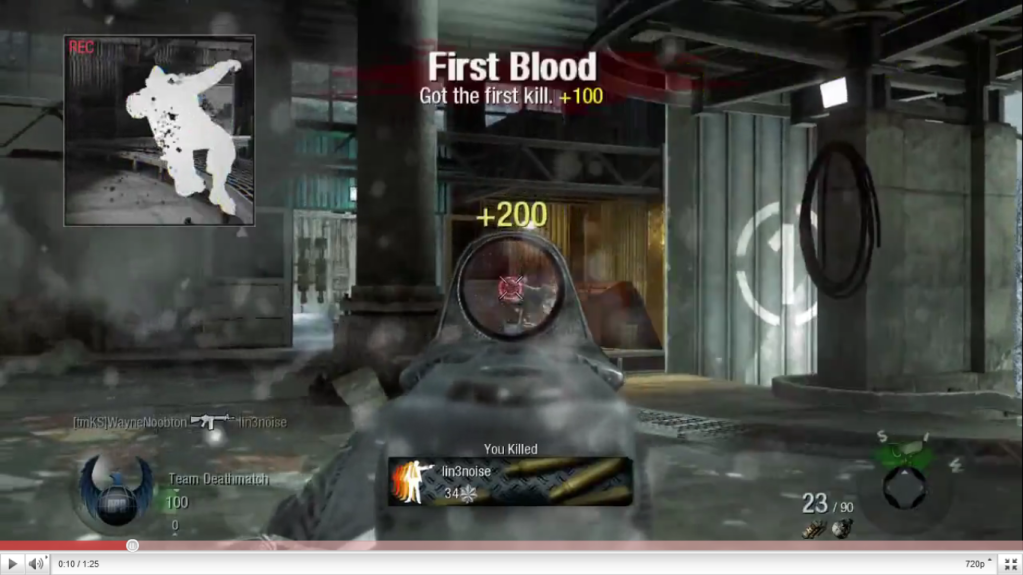
"Boom! Headshot!" ...No? Too much?
 Take a look at the screen above you. This is the image that will greet you every time you bust a cap in a fool while playing Call of Duty. That little yellow number there? That's the exact amount of XP you just recieved. And you get those little yellow pop ups for EVERYTHING. Shoot down an enemy plane? Little yellow pop-up. Get five kills while crouched? Little yellow pop up.

Combine this with the fact that this XP is constantly unlocking new guns, skills, perks, camo styles, name tags, and tons of other things, and you start to understand why playing can become so addictive. You're not just murdering people online for fake points, you're murdering people online so that you can murder them better.

Balance

With so many unlockables, the game has to be hideously unbalanced right? Especially since these are such throwaway games? You'd think that, but it's strange, other than the ridiculously powerful knife in the original Modern Warfare, I've never had a complaint about the balance of the game. The better guns are more powerful, sure, but not unreasonably so. It's a game about getting the drop on your opponent. If you can see them and they can't see you, they're gonna die. The opposite is also true. It's only when you both see each other at the same time that who's using what gun comes into play, and then it's usually the guy with the shotgun who wins.

Speed

Unreal Tournament was the first real twitch game I played, and it spoiled me. I remember playing Halo for the first time, and thinking, "Man, I'm moving so slow." It took picking up the original Modern Warfare for me to not feel that way anymore. Your default walking speed is pretty fast. Your sprint speed is downright crazy. Aiming takes just a twitch of the thumbstick. (Which is where the name "twitch gaming" comes from. And that moving so fast makes you twitch.) And dying, which in other "realistic" shooters like Counterstrike and Battlfield can banish you to the edge of the battlefield for as long as half a minute, well dying only lasts maybe a second before you're back in and killing some more. It's a damn fast game, and requires lightning reflexes to keep up. Which makes it ten times as fun as most shooters out there, and ten times as addicting.

These three things, along with good map design and a gigantic playerbase that means you're never waiting to play, lead to a game that you can literally play for hours and will almost never get bored. It's the best multiplayer shooter available right now, and because they hardly ever change anything, each new addition that comes out will be just as good. Nothing is ever going to topple Call of Duty until someone, once again, reinvents the wheel. But in order to do that, they can't just make a better shooter - you could argue that's been done. They have to make a better shooter, AND they have to make it more accessible. The only people who've ever come close are Bungie, and even they fell by the wayside. 

Chime in with your thoughts down below.

Wednesday, January 30, 2013

How Geeking Out Helped Me to be a More Social Person


- By Jarys
              The Geek or Nerd as social pariah is a long standing trope in both fiction and social expectation. Geeks are often equated with other groups perceived as outsiders, such as the neuro-atypical and some ethnic minorities. Paradoxically, this image is internalized both individually among geeks and as a group as the label brings us together in pursuit of greater socialization. We often see ourselves as loners and use our socially fraught past as a badge of honor. Unfortunately, I have seen geeks judge and reject other geeks on the grounds the subjects were “too socially acceptable” to mainstream culture. Ironically, these often come from straight white male nerds (a term I am working to use interchangeably with “Geek”) , the real point of the sentence being to point out that I have my own ideas on what makes someone “socially acceptable”. We all do.  
Hipsters are NOT socially acceptable to Jarys

                In the end Nerds/Geeks are people who are perceived to be outcasts, outsiders, and outliers, who tend to identify with that image, this doesn't define the group, but it’s a general characteristic. It’s something that defined nerdiness for me before I realized I was a nerd.  My father is a nerd for Tolkien, was a computer game fan for a while, and generally loved the science fiction and fantasy genre. He had a wondrous relationship with Star Wars, which he engendered in me by showing me A new Hope very early. My mom less so, though she was very studious, loves historical fantasy, and eventually became a new age enthusiast. However I wouldn't say I grew up in a nerdy household, because both my parents (especially my dad) would repeat to me how socially undesirable it was to be nerdy. Nerds were not well liked and my dad increasingly criticized my geeky pursuits as I grew up as something I should be embarrassed about and from which I should branch away. Throughout and after college both parents begged and entreated me to socialize outside of geeky culture, in fear it would close me off by its very nature. 
                It wasn't always this way, my love of Star Wars, reading books above my age’s reading level, legos, comic books, the Ninja Turtles and others were seen as “normal boy interests”. But as I grew up, my interests grew to new places (acting, writing, social science, roleplaying games) and my previous interests mostly didn't go away, much to my dad’s dismay. Video game consoles were banned from the house so that I wouldn't “be staring at the TV like a zombie for hours”. After watching “The Maltese Falcon” in 7th grade I began wearing a trench coat to school. I used birthday favors right before high school to leverage my mom to paint my room as a Star Wars/fantasy vista. Each would get me lectures and I eventually began bringing home Animmorph an comic books home in brown paper bags so I wouldn't have to hear lectures on appropriate reading for my age. Despite this my parents used these interests to reach out to me, buying me Star Wars books and memorabilia for Christmas. I don’t mean to give the impression that I hide to live a double life, but the judgment was there, especially the judgment of socially outcasting myself.
                What I try to tell my parents, something that took me a long time to learn, is how socializing it can be to be a geek or nerd. My interest in writing helped me make friends in the literacy club, where I made my longest lasting friends in high school. I made friendships that lasted outside of school over role playing and Shakespeare. At the time I saw these things as normal, but also a relief. I struggled with alienation throughout most of my life (still do, really) and connecting with people over common interests really helped me feel less alone. In college, I discovered Player Versus Player, a webcomic that touted being a nerd or geek as a social group, and I realized I was such a person and so were most of my friends in High School. I didn't make any lasting friendships until I connected with people on those interests (I tried partying and found it very alienating). I made friends with Esther over Morrowind and the occult and Mike and Mae Linh over role playing games and Star Wars. More friends were added as I began playing card and board games, going to LARPs, and tried online communities. Eventually, the two long term relationships I've had, with a female friend of a friend in college and a young man after college, both arose from shared geeky interest. I find, in dating, I am attracted to geeks because they tend to be comfortable displaying intelligence, a trait I find very attractive.

Check out that intelligence on Spidey. MmmMMM

                What I discovered is that, while we are probably Geeks because we are so unabashedly enthusiastic for these rarely popular pursuits, we dive in to these pursuits in part as a salve to the heartache of being alone. Finding others who like to do what we like to do allows us to structure socialization around those hobbies and interests safely. LARPs especially allow a safe space to practice being more social, in which failure can we forgotten as a type of game play that did not get the desired result. In discussing the way themes of science fiction reveal truths about humanity we get to see the humanity in our friends. In costuming, role playing, and writing we allow ourselves to celebrate ourselves in a way in which we can safely expect positive feedback and constructive criticism.
                To see others who like what we like, do what we do, we feel less alone and more human. We feel a part, one of a group, like we belong. This is a very human need and solution. It’s what brings people to sports, to fashion, to any social activity. The difference is that geeks and nerds exist under a unified culture defined by uninhibited enthusiasm and unpopular interests, ironic because there is no one name for this group. As geekiniess begins to become more socially acceptable the definition will change. Acceptance of nerdy pursuits has already helped show the enthusiasm characterized by far more “normal” pastimes, terms like “baseball nerd” and “Policy geek” being examples. The greater acceptance of women within geeky culture recently has truly helped this process as interests in knitting, themed painted nails,  and others once seen as exclusively female have come to be seen as geeky, geeky and female no longer being socially mutually exclusive.
                In the end, what I try to tell my parents is that my interests are just interests, like anyone else’s. They help me meet people like any hobby. They distract me from other parts of my life, like any hobby. They are fun and they appeal to me. What I tell myself is that my past of feeling alienated and weird arose not from my interests but from different matters.  Geekiness is part of who I am (I don’t really see myself as nerd) and something I like about myself. My interests don’t remove me; they bring me closer to people I want to be with. 

Friday, January 25, 2013

Episode 53: The Magic Shop!

Picture Mike and Jarys get together to take a look back on their Christmas, and you're invited! Also, Mike goes on the longest Bruce Coville tangent of all time, and we discuss The Name of the Wind, Evil Dead, and more!

Episode 53!

Sunday, December 23, 2012

Episode 52: Happy Holidays from the Ace of Geeks!

In our last podcast of 2012, the Ace of Geeks Podcast dives into reviewing the Hobbit, discussing all the trailers for next summer's movie season, and the upcoming adaptation of Ready Player One! PLUS: With the Holidays coming up, we will teach your friends and family how to gift for a geek!

Episode 52!

Thursday, November 22, 2012

Episode 50: Six inches of - no, I'm not calling it that. Part 2

Picture The 50th Episode of the Ace of Geeks Podcast is live! My god! Nearly three and a half hours of content to fill your eardrums! We are joined by Mae Linh Fatum and Alexis George to play an epic game of Fiasco set in the world of Harry Dresden. We also bring in Keith Justice Heyward of Henshin Justice Unlimited to review the newest Kamen Rider - Kamen Rider Wizard, and we talk to Leia Calderon-Rox of IHOGeek to review the new Disney video game film Wreck-it-Ralph! It's so big, we had to break it into two parts! Enjoy!

Episode 50: Part 2!

Episode 50: Six inches of - no, I'm not calling it that. Part 1

Picture The 50th Episode of the Ace of Geeks Podcast is live! My god! Nearly three and a half hours of content to fill your eardrums! We are joined by Mae Linh Fatum and Alexis George to play an epic game of Fiasco set in the world of Harry Dresden. We also bring in Keith Justice Heyward of Henshin Justice Unlimited to review the newest Kamen Rider - Kamen Rider Wizard, and we talk to Leia Calderon-Rox of IHOGeek to review the new Disney video game film Wreck-it-Ralph! It's so big, we had to break it into two parts! Enjoy! Here's part one!

Episode 50: Part 1!