If you’re anywhere on the internet today, you've heard that Marvel has decided in it’s new issues to expose one of their time traveling young X-men as gay. Normally, as a member of the LGBTQA+ community, this would be so exciting! Instead, I am left with nauseating rage. My straight friends were confused as to why this entire set of panels makes me feel like Marvel is dipping into Mugatu's medicine cabinet!
I mean, come on!
So first off, let’s start off by saying this... Just because there’s LGBTQA+ representation does NOT mean we should be automatically happy about it. DC has had a habit of handling it very poorly, whereas Marvel has had a habit of handling it very well. So that’s what makes this even more upsetting. This treatment of the characters in this scene is extremely disgusting and presents a lot of problems that are prevalent in our community and things we deal with everyday. It’s disappointing to see this ignorance out of a company who at one point was bold enough to put a gay wedding on the cover. It’s like going to an ice cream store and the ice cream has been flavored with... well... shit. Spoilers ahead. (Click on all the comic panels below to expand them.)
This review will contain spoilers for the pilot episode.
Five minutes in to the first episode of "Powers," the Playstation Network adaptation of the comic book by Brian Michael Bendis and Michael Avon Oeming, you know exactly what type of show this is going to be. After an intriguing and well shot beginning featuring a young girl, a dirty old man, and a mysterious drug overdose, we snap immediately to an Entertainment Tonight feature starring Mario Lopez. The feature is about our main hero, Christian Walker (Sharlto Copley), and covers his entire backstory in the most awkward exposition dumb starring Lopez since an episode of Saved by the Bell.
We're back with a new (meaning our second ever) Geekly Roundup!
If you haven't already seen it, check out our new companion Geekly Roundup podcast! This week, Mark, Mike, and Ben take on some of the news found in the Roundup, as well as the upcoming Marvel Netflix series, and some thoughts on how indie game development is changing the way games come to market.
This week we've got news about everything from No Man's Sky to Pitch Perfect to the recent news about Maxis Emeryville -- and yes, there's even more Wil Wheaton. No Roundup is apparently complete without Wil Wheaton.
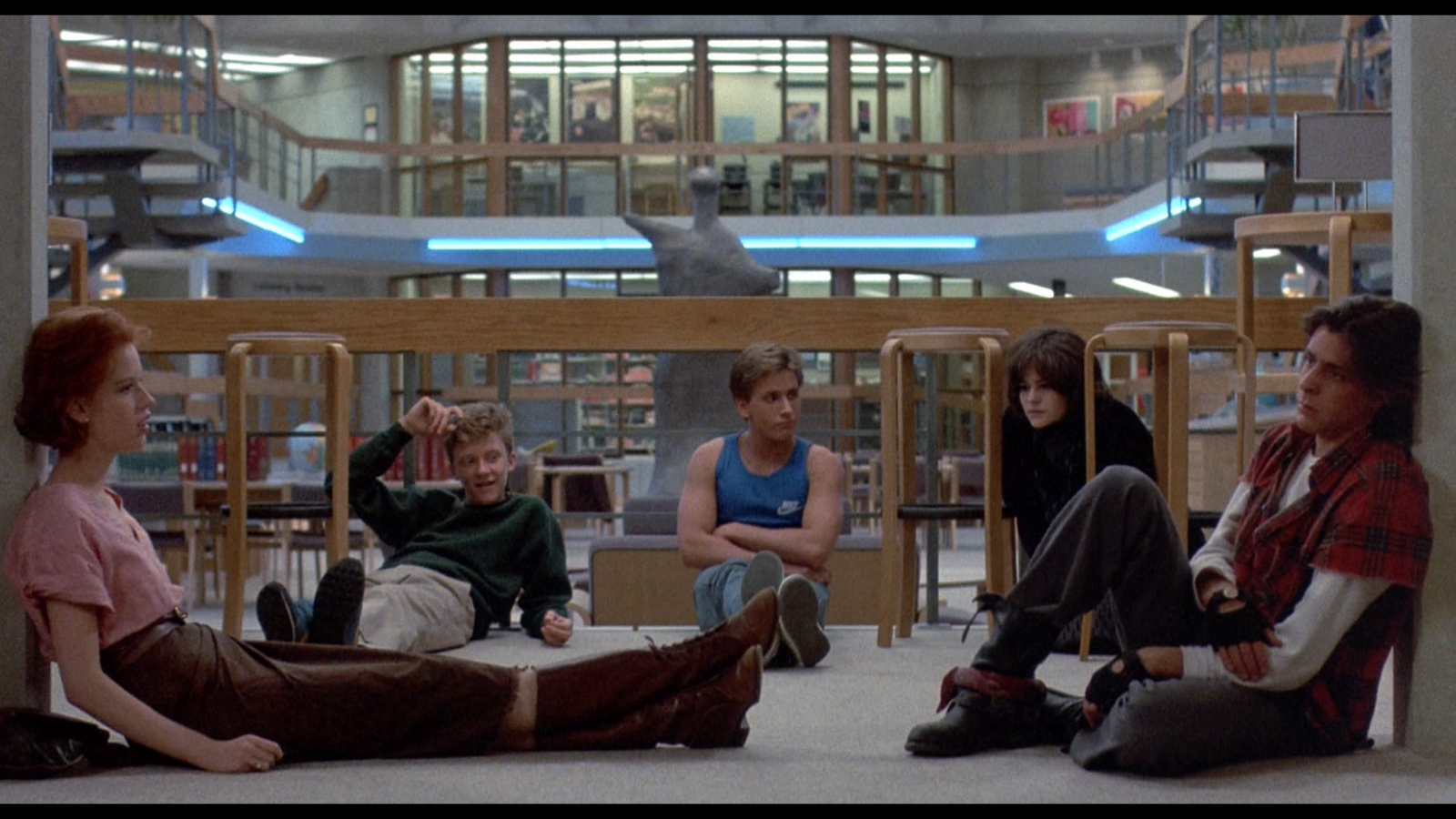
One of John Hughes' most iconic 80's films turns the big three-oh this month! Originally released in February of 1985, The Breakfast Club is coming back to theaters for limited engagements on March 26th and March 31st. Screening with it will be a featurette with interviews from cast members Anthony Michael Hall, Judd Nelson, Ally Sheedy, and and John Kapelos as well as film makers Diablo Cody (Juno), Amy Heckerling (Clueless), and Michael Lehmann (Heathers). The Breakfast Club 30th Anniversary Edition will be released on Blu-ray and DVD on March 10th.
30 years ago, I was out of high school and still trying to piece my life back together after a traumatic event. I needed a distraction, so I went to a movie. A friend of mine was into John Hughes' films - "Pretty in Pink" was her favorite. She recommended I go see "The Breakfast Club" because she thought I would enjoy it. She was right. I enjoyed it... so much so that I bought tickets to the next three showings and just stayed in the theater, watching it over and over.
When I left the theater, I had Simple Minds stuck in my head singing "Don't You (Forget About Me)" on a loop, and I decided to take a long walk instead of going directly home. I walked from the theater down the main drag along the beach, and stopped at the beach park across the street from the zoo. (The bonus about growing up in Hawaii is that everything is across the street from the beach.) I sat on the wall, and I felt like life had become so surreal. I had just watched a movie that could have been about my own high school life. And now I was gonna sit on a wall at the beach and reflect for a bit. I knew at least one of these characters personally. They all live inside my head, and I know at least one real person for every personality type represented in this movie.
So there we were in detention, with Principal Verne. A jaded, angry man. He once enjoyed his job as an educator but not anymore. He gives everyone a lecture with the rules - "no talking, no laughing, no sleeping." He gives them an essay assignment. He wants them to write an essay telling him who they think they are.
Brian Johnson was the "brain" of the group - the "neo-maxi-zoom-dweeb." He was probably the one most likely to have a comic book collection that included Action #1 in pristine, mint condition. He was also under a lot of academic pressure from his parents. This resulted in Brian's brief suicidal depression over a failed shop project, and he did something that landed him in Saturday detention.
Andy Clarke was the "sport" of the group. Back in the 80's (at my school, anyway), a "sport" was someone who was on the track, wrestling, or swim team. A "jock" was someone who was on the baseball, basketball or football team. In today's vernacular, they would all be "jocks" or just plain athletes. Andy was on the wrestling team, and his father put a lot of pressure on him to win. This resulted in an unfortunate peer pressure situation that Andy didn't handle well, and he ended up in Saturday detention as well.
Claire Standish was one of the popular girls. Her parents were going through a messy divorce, and she was milking it for all she could get. A spoiled rich kid, she was in detention for skipping class to go shopping.
Allison Reynolds was the "weirdo." She made a pixie-stick and Cap'n Crunch sandwich (she may have added some Fritos in there too, I couldn't ever really tell, even after watching it four times in a row on the big screen and countless times on DVD) after tossing her lunch meat up in the air. Like the others, she also had issues - at one point she claimed to be a nymphomaniac. Nobody knew why she was actually in detention until later.
John Bender was the delinquent. He was in detention working off a string of offenses, none of which were ever made clear. What was made clear ("Crys-taaalll!") was that he would be having 7 more weeks of it. He had a reputation as being the campus bully. It turned out that Bender's behavior was masking some pretty serious issues at home. At first the group didn't believe him when he said he was being abused. Then he showed them the scars.
The movie as a whole takes us through a day in detention for these kids. Andy and Claire already knew each other, they ran in the same social circles. Everyone knew who Bender was, he was the campus "waste-oid," the one all the burners would hang out with. Allison was the loner, and Brian hung out with the math club.
During the course of the movie, the kids get to know a little more about each other, albeit the hard way. They start by insulting and picking on each other. But, they have a common enemy in Principal Verne and they start covering for each other whenever Verne comes in to check on them. At one point, Verne asks if anyone has to go to the lavatory.
The group takes this opportunity to go to Bender's locker to get his stash. As they are trying to get back to the library undiscovered, they have to duck and hide several times as Verne is roaming the halls too. Bender stuffs his weed in Brian's pants, and takes off toward the gym to draw Verne away while the group gets back to the library. This works, and Bender is busted in the gym.
Verne locks him in a storage closet. He gets up into the ceiling, and crawls back to the library. When he crashes down through the ceiling tiles, Verne comes in to see what the ruckus was. Bender ducks under the table where Claire is sitting. They all pretend to not know what the ruckus was. When Verne leaves, Bender retrieves his stash from Brian.
The group bonds over Bender's weed, and they have a melancholy group heart-to-heart, during which Brian, Andy, and Allison reveal the reasons that they are in detention. Brian failed a shop project. Due to pressure from his parents, he felt a deep guilt over it. He brought a flare gun to school, but it was discovered when it went off in his locker.
Andy was under pressure from his dad (a bully of a former athlete, trying to live vicariously through his son) to be a winner - be the popular guy, be the champion wrestler, be everything. He gave in to locker-room peer pressure and taped a hairy kid's ass cheeks together. He knew it was wrong to do it, and he is now contrite and has many regrets and feels much shame and remorse over it. Allison... simply had nothing better to do.
Brian asks if they will still be friends on Monday. Claire says she doesn't think so. She tries to justify her answer by attempting to explain how the campus social pecking order works, but the group isn't buying it. They all promise each other that they won't treat each other like how the rest of the school treats them - like freaks.
That scene was probably the most emotionally painful scene of the whole movie for me, because the opportunity for them to lay it all on the table was there. The thing that hurt the most for me was that this kind of soul-baring moment did happen more than once for my group of friends (without the weed), and yet not a single one of us realized the significance of it. In fact it all just ended up being empty words. So my pain was for the loss of what I felt could have been truly defining moments, however fleeting, for my group of friends.
Bender crawls back to his storage closet, and Claire gives Allison a makeover. Then she goes to make out with Bender in the storage closet. By the end of the day, Allison and Andy have paired off as well. They have all talked Brian into writing a single essay for Verne from all of them, and it goes something like this:
Raven Knighte is an avid movie, TV, and cosplay fan.
Did you enjoy this article? Follow us on Facebook to get more great content! We have a weekly podcast you can find on our main site. Also follow us on Twitter and Tumblr!
This is it, folks. After the hilarious trolling of releasing an ant-sized Ant Man trailer, Marvel has given us the first real trailer for the film. And boy does it look...well, see for yourself:
Based on Thomas Maier’s biography of the same name, Showtime’s ‘Masters of Sex’ is still topping reviews well into its sophomore season. The period drama follows the lives of two revolutionary scientists in the late 1950’s, James Masters and Virginia Johnson, and their groundbreaking study of human sexuality.
But while sex sells, there is certainly more driving the success of the show. First, for a headliner show about sex, ‘Masters’ is being proclaimed as one of the most progressive programs available, and it really is. The show is being hailed as a feminist revelation, and having Lizzy Caplan of Mean Girls fame hasn’t hurt in that respect. A single mother of two balancing work and a driving focus on her scientific work, Caplan’s Johnson is pragmatic, independent and wholly believable. Her standout performance is shared by a cast of other rounded-out women. With Sarah Silverman joining the cast as Helen, who shares a lesbian romance with lover Betty (played by Annaleigh Ashford), the show is one of the first where women and the sexual “outliers” have more screen time than the heterosexual men. The historical exploration of gay sexuality with the character of Barton Scully, played by Beau Bridges, is dark and definitive. In an attempt to renew his relationship with his wife, the closeted husband undergoes shock therapy, a practice typical of the time, in order to extricate his homosexual instincts. The treatment is shown as something entirely normal, for an age that’s younger than people walking the earth. At times, the understandings of sex and humanity seem juvenile, and its easy to dismiss them as ignorant. But what the show does so beautifully is a measurement of progress. Scully’s wife has trouble describing an orgasm, because she’s never had one. Another couple enters Masters office with the issue of infertility. In a comic scene, Johnson needs to explain the practice of sex, because simply “lying with each other” does not produce a child. Measurement of educational, scientific, and sexual progress is at the heart of the show.
‘Masters’ plays out like a modern stage drama: the sets are minimal, the language is stark, and the success of the show is driven by the strength of the characters. If sex is power, then the drama of the show is driven by who is in control of the scene, which lends to brilliant interactions in dialogue. Every character has something they’re lying to themselves about, whether it’s the justification behind Johnson and Masters’ affair, or a character’s personal sexuality or ignorance thereof.
Then, there’s the actual sex. Each scene acts to provide something other than visual smut. Every single time sex is on the table, it deepens the larger plot line, whether it’s by illustrating the lack of intimacy a closeted gay man has for his wife, or propels the themes of self-deception and power the show explores so densely.
But on top of all of this, ‘Masters’ has utilized television as an educational tool. Sure, most privileged television viewers watching the show have gone through course sex-educational courses. In the first season finale, a very basic list of the study’s very real findings are given significant air time: the anatomy of a female orgasm, the four phases of human response, that homosexuality is not a human illness, that masturbation does not cause illness or insanity (which was, believe it or not, a held belief historically) and that sexual instinct does not dissipate in old age, among a great deal of other things. “This is a scientific study, not a stag film in a frat house,” Masters notes. The original published findings of the work was seen as a liberation of sexuality and human biology, and the relevance of that is still very present. Promoting awareness of the pitfalls of relationships, the patterns of human behavior and the nature of sexuality, and the depths of self-delusion, the show not only rekindles interest in sexual education but explores its ramifications.
‘Masters of Sex’ airs Sundays at 10PM on Showtime.
-
Alexis George is a San Francisco writer. She can unfortunately be found on Twitter.
Did you enjoy this article? Follow us on Facebook to get more great content! We have a weekly podcast you can find on our main site. Also follow us on Twitter and Tumblr!
A few weeks ago, the geek world fell into despair. Guardians of the Galaxy, far and away the best movie of the summer, had been beaten in its second weekend by a movie everyone had been dreading - the Michael Bay-produced adaptation of the Teenage Mutant Ninja Turtles. And with good reason - everything we'd seen in the trailers showed us a bland, humorless world of Bayformers style explosions and giant robots.
This weekend, given two hours or so to see a movie and not able to see Guardians for the fourth time, I finally gave in a purchased a ticket to Teenage Mutant Ninja Turtles. Was it bad? Was it really bad? Was it Revenge of the Fallen bad? All these questions and more will be answered, as you read on.